
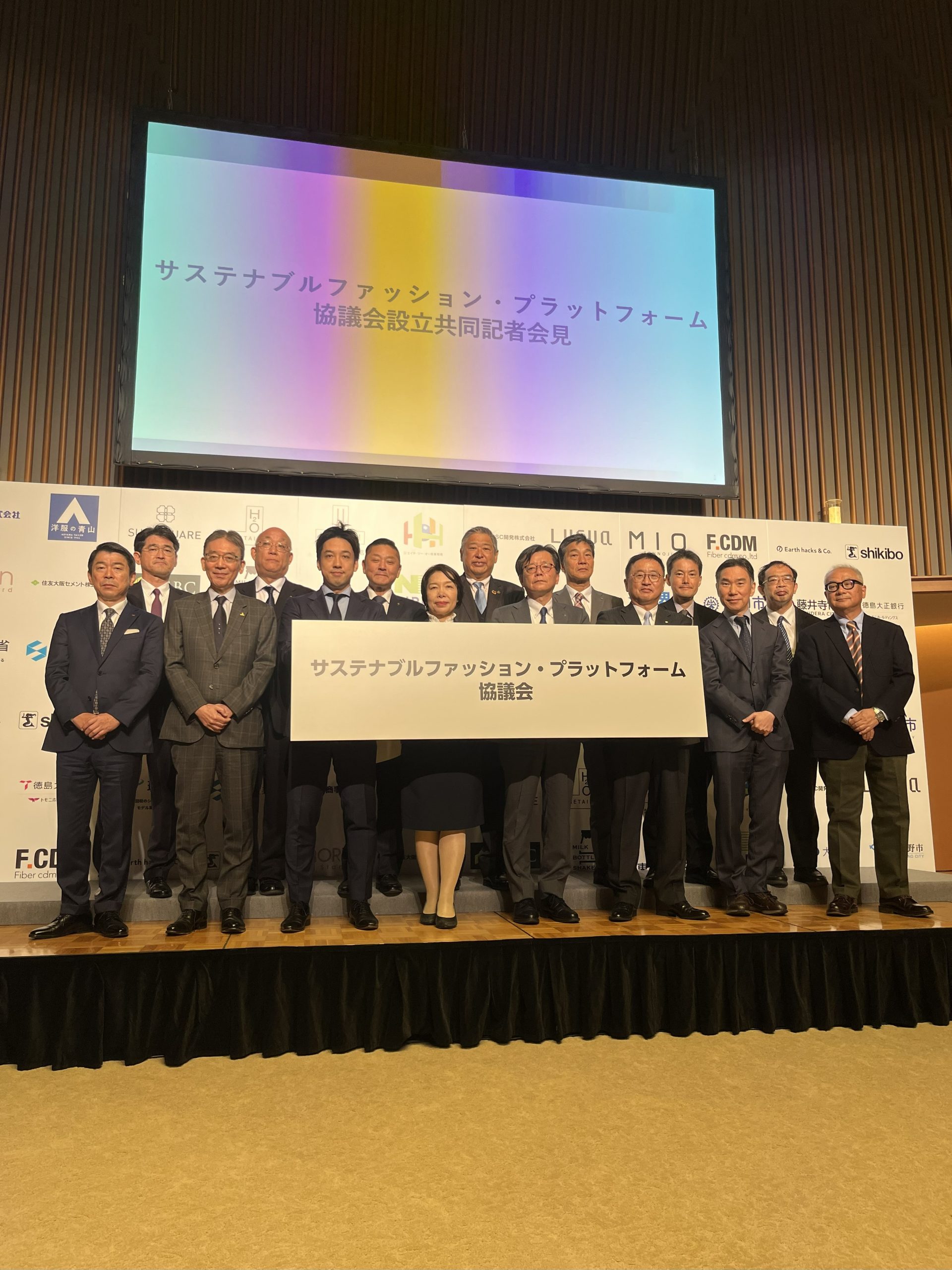
On November 26, the “Sustainable Fashion Platform Council” was established through collaboration between Osaka Prefecture and private companies. This public-private partnership aims to collect, sort, reuse, and recycle used clothing within Osaka Prefecture. The initiative has been selected for two consecutive years since 2024 as part of the Ministry of the Environment’s “Model Demonstration Project for Building a System to Collect Used Clothing.” With the establishment of the council, the goal is to realize a regionally co-created circular economy for apparel.
In fiscal 2024, approximately 4.9 tons of clothing were collected at 65 locations, with sorting and reuse promoted. To reduce discarded clothing and achieve fiber-to-fiber recycling, the council was established to further advance sustainable fashion.
By fiscal 2030, the council aims to reduce by 8,000 tons the amount of used clothing incinerated or landfilled in Osaka compared to 2020 levels, while collecting more than 8,000 tons annually. It also plans to process 3,500 tons per year domestically through reuse and recycling.
The council is chaired by four companies: H2O Retailing Corporation, Aoyama Trading Co., Ltd., JR West Japan Shopping Center Development Company, and Fiber cdm Co., Ltd. In addition to Osaka Prefecture and municipalities such as Sakai, Fujiidera, Izumisano, and Suita, companies including Shikibo, Moririn, and Sumitomo Osaka Cement are participating. Together, they have built a public-private framework that divides responsibilities across the entire supply chain—from collection and sorting to reuse and recycling.
Naoya Araki, President of H2O Retailing, emphasized, “Economic rationality is essential for sustaining these activities.” He stated that the council aims to cover circulation costs through high-value transactions and to establish a business model that prioritizes supplying recycled fibers to member companies.
The operational framework was also revealed. Aoyama Trading will provide 38 stores in Osaka Prefecture as collection points, “serving as contact points with consumers” (President Taizo Endo). Fiber cdm will utilize sorting facilities in Osaka and India, explaining that “we can handle the annual collection target of 8,000 tons” (Chairman Yasunari Izumiya).
Shikibo Ltd. will not only upcycle discarded clothing back into yarn but also expand into biomass plastic pellet production using pulverized cotton materials. Executive Officer Yoko Chujo expressed determination: “We want to broaden the scope of waste fiber utilization and play a proactive role in both recycling technology and production.”
Moririn Co., Ltd. is advancing initiatives through “PANECO,” a recycled board made from discarded clothing. President Shunsuke Mori commented, “By learning from each other, we can drive the textile industry into the next era.” For clothing that is difficult to recycle, Sumitomo Osaka Cement Co., Ltd. will utilize it as thermal energy in its manufacturing process, aiming for a zero-waste system.