
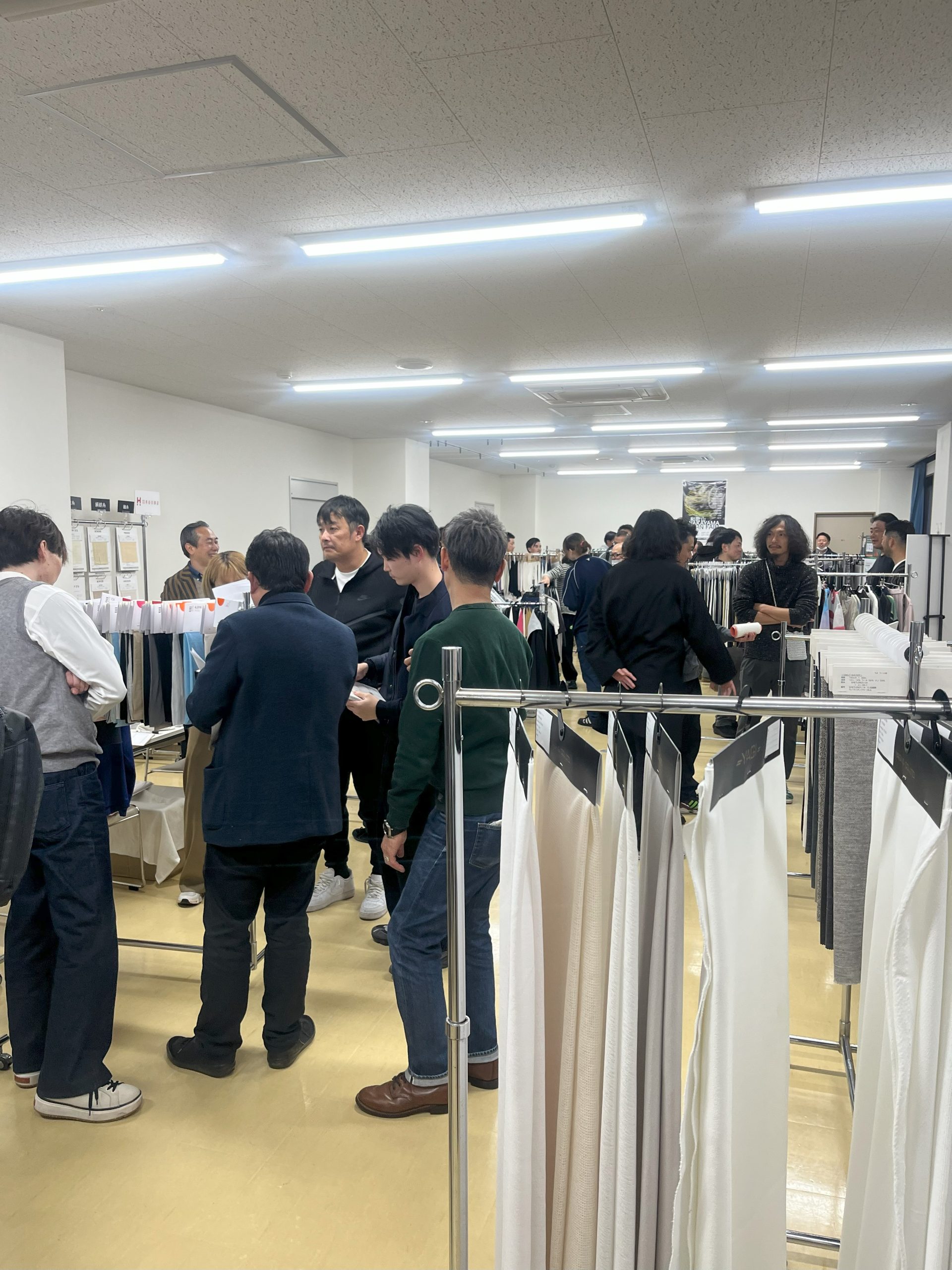
The Wakayama Knit Industrial Association held the first-ever “Wakayama Yarn Fair” on December 4–5 in Wakayama City. “Our goal is to pass on the Wakayama production area, which has continued for more than 100 years, to the next generation and enhance its added value through new manufacturing,” said Chairman Tomohiro Yamashita (President of A-Girls Co., Ltd.). Sixteen companies, including joint exhibitors, participated as a meeting place for yarn and circular knitting technology. Some sample shipments were decided on the spot, and lively business negotiations continued at the venue.
The idea for the event originated at this year’s New Year’s business card exchange meeting, where voices were raised saying, “We want to hold a yarn exhibition in Wakayama.” The cooperative also called on companies with few connections to the region, aiming to create innovation through “matching with new materials.” The venue was set near JR Kimiidera Station, where factories are concentrated, making it easy for cooperative members and on-site staff to drop by between tasks.
Companies with ties to Wakayama showcased a wide range of high-value-added yarns. Toyobo Textile Co., Ltd. introduced a recycled cotton yarn now in mass production in Wakayama, which drew attention for its vintage texture.
Chori Co., Ltd. presented polyester spun yarns that can be dyed at normal pressure and low temperatures without impairing the feel of blended natural fibers. STX Co., Ltd. displayed fabrics knitted in Wakayama using stock yarns , a yarn blended with waste cotton, saying, “We want on-site staff, who usually only see greige fabric, to experience the texture after dyeing and finishing.”
Shikibo Ltd. and Shinnaigai Textile Ltd. showcased yarns such as fine-denier modal for innerwear and mélange yarns made from cotton-cupro blends. Teijin Frontier Co., Ltd. proposed a special dual-structure yarn combining high-shrinkage polyester and lyocell, for underwear applications. Yagi & Co., Ltd.emphasized the soft texture of knitted fabrics made with softly twisted combed yarns, processed at Fujibo Textile’s Wakayama factory.
Environmentally conscious materials also stood out. Asahi Kasei Advance Corporation unveiled recycled yarns made from Bemberg nonwoven fabric scraps and 100% cotton worsted yarns. Toyoshima & Co., Ltd. introduced new slub yarns made from organic cotton.
Creating Connections with Other Production Areas
Companies with limited ties to Wakayama expressed interest, saying, “We want to know what kinds of yarns are in demand,” bringing fresh perspectives to the field. Abilas Corporation showcased woolly nylon yarns available in more than 500 colors. Miyama Co., Ltd. introduced 100% cotton cool-touch yarns and paper yarns derived from recycled milk cartons.
Shimomura Co., Ltd. and Hasegawa Corporation highlighted added value through twisting and processing technologies. Tosco Co., Ltd. proposed ramie yarns, Fukaki Woollen Textile Co., Ltd. presented cashmere woolen yarns, and Kyototex Company Ltd. offered lamé yarns suitable for post-dyeing.
At the venue, exhibitors commented, “We were able to have close business talks with each company,” while visitors said, “There were many yarns I had never seen before, and I gained hints for development.” Chairman Yamashita expressed his enthusiasm for further growth of the production area, stating, “Based on the response this time, we want to connect it to the next event.”