
As 2026 begins, global conditions are becoming increasingly uncertain and unpredictable. However, Toray Industries, Inc. President Mitsuo Ohya offers an optimistic outlook, saying, “There are downside risks, but the economy is heading toward recovery.” This year marks a milestone for the company as it celebrates its 100th anniversary and launches a new medium‑term management plan. We spoke with him about the direction of the global economy, the textile industry, and Toray’s future path.
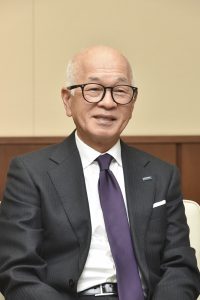
How do you foresee the global economy and business conditions in 2026?
Ohya: Although the pace of expansion will vary, we expect economies across countries and regions to recover in 2026 compared with 2025. I don’t see any major reason to doubt that outlook. The automotive industry is also expected to improve from last year, and I anticipate a gradual recovery trend throughout this year.One downside risk is U.S. monetary policy. If interest rates are cut, it will affect global capital flows and exchange rates. In Japan, interest rate hikes are being discussed, and we need to closely monitor how this will impact consumer spending. In any case, it is important to manage the business with the assumption that “downside risks exist.”
What about the impact of U.S. reciprocal tariffs and deteriorating Japan‑China relations?
Ohya: Regarding U.S. tariff policy, in the textile sector, prices with customers had already been set by the time the tariff rates were announced, so there was no impact. There may be requests for price reductions going forward, but we have firmly established “strategic pricing,” which ensures we receive fair compensation that reflects the value we provide, so I am not concerned. As for worsening Japan‑China relations, I do not believe it will significantly affect our business. Although China’s economic slowdown is often pointed out, its growth rate remains higher than Japan’s, and the government is implementing stimulus measures. However, in consumer goods, the widening gap between strong and weak segments is a concern.
In Japan, we continue to see restructuring among synthetic fiber manufacturers.
Ohya: Each company is acting based on its own policies, so I have no comment on those decisions. However, speaking about the textile industry as a whole, I feel that concerns about supply are growing. Expectations for Toray’s role will only increase, and we will devote our efforts to ensuring that production regions and markets can be maintained and expanded.
Toray celebrates its 100th anniversary in such a year.
Ohya: If we compare it to a woven fabric, our corporate philosophy-“contributing to society through the creation of new value”—is the warp thread. Management that adapts to the times is the weft. Successive generations of management have continued to weave these threads together, creating our 100‑year history. These warp and weft threads will remain unchanged for the next century as well.
Toray will launch a new medium‑term management plan starting in fiscal 2026 (ending March 2027).
Ohya: The current medium‑term plan, which concludes in March 2026, has simultaneously advanced growth strategies and structural reforms. This overall framework will remain largely unchanged in the next plan. One key point will be reaping the returns from the nearly ¥550 billion in investments made under the current plan. At the same time, we expect to begin making investments aimed at growth in the following medium‑term plan as well.Our focus will be on how much we can expand growth areas such as carbon fiber, separation membranes, and hydrogen‑related businesses. On the other hand, some businesses are not generating sufficient profit relative to invested capital. We will pursue structural reforms with the same intensity as our expansion strategy. By doing so, we can clean up low‑growth, low‑profit businesses to a significant extent.
How do you view growth and structural reform in the fiber and textile business?
Ohya: Our growth areas are threefold: integrated apparel production, artificial leather, and airbags. We will continue to invest in facilities and strengthen these businesses. In terms of structural reform, we will continue efforts in polypropylene spunbond nonwovens (PPSB) and polyester staple fibers through the “Darwin Project” (D‑Project), our profitability improvement initiative. Additionally, although it is undecided whether it will be formally included in the D‑Project, the polyester‑cotton blended business requires reform. We have been working on it continuously, but we now feel that fundamental restructuring is necessary. Re‑engineering low‑profit segments within our domestic affiliates will also be one of the challenges in the next medium‑term plan.
Will PPSB production capacity be reduced?
Ohya: Across Asia—including China and India—populations are growing, and demand for adult diapers is increasing. The issue lies in oversupply. As with yarns and fibers in the past, we must compete in markets and regions where we can win. In some cases, particularly at our Korean sites, we may shut down older equipment. In China, where we had struggled, we are now seeing signs of returning to profitability, meaning we can complete the “one‑step” phase this year. The next step is determining what measures to take in India and Indonesia. The question is how much high‑value‑added product we can generate with our existing facilities. Discussions on capacity expansion and re‑engineering are currently underway.
What is the medium‑term strategic direction?
Ohya: The next medium‑term plan is being formulated with a clear vision of what we want the company to look like around 2030. From there, we identify the challenges we face today and how to overcome them. Having surpassed ¥1 trillion in revenue, the next target for the fiber and textile business is ¥100 billion in operating profit. We are drawing up a roadmap to achieve this around 2030 through expansion of growth areas and structural reforms.